
Astaxanthin & Skin Longevity: The Antioxidant Inside Ingenious Collagen
By Julia Hart Electric Facialist
When we talk about supporting collagen, we often focus on encouraging the skin to make more of it. But I’m just as interested in understanding the processes that cause it to break down.
That is what makes Astaxanthin such an interesting ingredient in Ingenious Collagen+. This naturally occurring red pigment has antioxidant activity and a growing body of skin research behind it. Alongside marine collagen peptides and hyaluronic acid, it brings another dimension to the formula: the possibility of supporting skin by addressing oxidative stress.
For me, this is where skincare from within becomes interesting—looking at the environment our skin cells live and work in, alongside what we apply on the surface.
A Red pigment with a long scientific history
Astaxanthin may feel like a modern beauty ingredient, but its scientific story goes back to 1938, when Richard Kuhn and Nikolai Sörensen published research on Astaxanthin and related pigments.
It belongs to the Carotenoid family. These are the pigments behind many of the Yellow, Orange and Red colours we see in nature.
Astaxanthin is one member of a fascinating pigment family. Discover another in my article on Lutein and Marigolds, the golden carotenoid included in Beauty Focus Collagen+.
One of the best-studied natural sources is the freshwater microalga Haematococcus pluvialis. Under challenging conditions, including intense light and nutrient deprivation, this normally green organism accumulates Astaxanthin and turns Red.
I love that connection between nature and skin science. An ingredient associated with an organism’s response to environmental stress has become a subject of research into how we might support human skin. Of course, what happens in algae is only the beginning of the story; we still need studies in people.
Ingenious says the natural Astaxanthin used in its products comes from microalgae cultivated in Sweden.
Algae also introduces us to other intriguing compounds. In Brown seaweed, one of these is Fucoidan—a very different molecule explored in my article, Fucoidan Explained.
What does an antioxidant actually do?
Oxidative stress occurs when reactive molecules overwhelm the body’s ability to manage them. In skin, UV exposure can trigger oxidative and inflammatory processes associated with damage and collagen breakdown.
Astaxanthin is particularly interesting because of its activity in lipid environments—the fatty structures that include cell membranes.
In a laboratory study using model membranes, Astaxanthin reduced lipid peroxide formation, a measure of oxidative damage to fats. Researchers linked this activity to its ability to trap radicals at the membrane surface and within it.
That gives us a plausible mechanism. It does not tell us exactly how much benefit a supplement will deliver to someone’s skin.
Laboratory skin-cell research has also found that Astaxanthin can reduce UVB-triggered inflammatory signalling and the release of MMP-1, an enzyme involved in collagen degradation.This is one reason scientists are interested in its potential role in photo-ageing.
Is it really thousands of times stronger than vitamin C?
You may have seen Astaxanthin described as “6,000 times stronger than vitamin C”.
These striking comparisons come from specific laboratory antioxidant tests. One frequently cited experiment measured how effectively different compounds quenched singlet oxygen—a particular reactive form of oxygen—under controlled conditions.
That is useful chemistry, but it does not mean astaxanthin gives your skin 6,000 times more protection. Antioxidants behave differently depending on their environment, concentration and the type of reactive molecule being studied.
Vitamin C also has its own essential roles, including in normal collagen formation. I prefer to think about the different jobs these ingredients perform, rather than ranking them by one laboratory number.
What does the skin research show?
The human research is encouraging, although still relatively small.
In a 2017 study, 65 women received either 6 mg or 12 mg of astaxanthin daily, or a placebo, for 16 weeks. The study ran from August to December in Japan, covering changing conditions of sunlight and humidity.
Skin moisture and wrinkle measurements worsened in the placebo group, while those measures remained broadly stable in the astaxanthin groups.This is best understood as a possible benefit for maintaining skin condition during environmental changes, rather than evidence of dramatic wrinkle reversal.
The researchers were affiliated with an Astaxanthin supplier, which is relevant when assessing the evidence.
Another study, published in 2014, examined a combination of Astaxanthin and collagen hydrolysate in 44 participants over 12 weeks. The combination improved facial elasticity and reduced water loss through the skin compared with placebo. Skin samples also showed changes in gene expression consistent with collagen support.
However, the study could not separate the contribution of Astaxanthin from collagen. It also found no significant difference in UV-induced DNA damage between groups.
These studies give us reasons to be interested. Larger, independent trials would help establish how reliable and meaningful the benefits are over time. Astaxanthin supplements do not replace sunscreen.
Why include it in Ingenious Collagen+?
Ingenious Collagen+ combines hydrolysed marine collagen peptides, a hyaluronic acid complex and natural Astaxanthin.
The rationale brings together three areas of skin support: collagen, hydration and antioxidant activity. Astaxanthin is included to address oxidative processes that may contribute to skin deterioration.
The study combining Astaxanthin and collagen supports the scientific interest in this approach, but it tested a different formula. We cannot assume the same results or claim that the ingredients have proven synergy in Ingenious.
Ingenious also reports a 12-week randomised, double-blind, placebo-controlled trial of its finished product, with 116 women recruited and 107 completing the study. The brand reports improvements in skin measurements.
That is finished-formula evidence, rather than proof of what Astaxanthin contributes on its own. The public information reviewed for this article is a manufacturer summary; it should be read with that context.

Where PRYSM iO fits into the picture
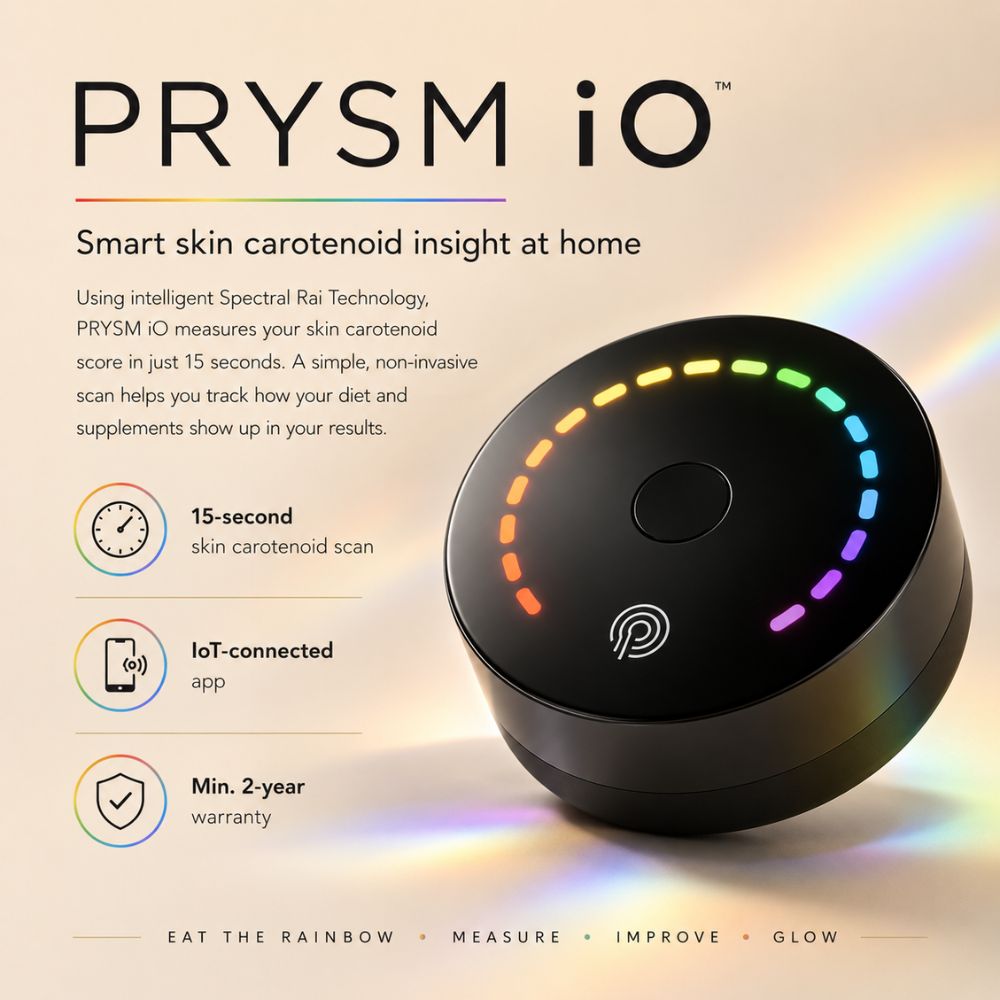
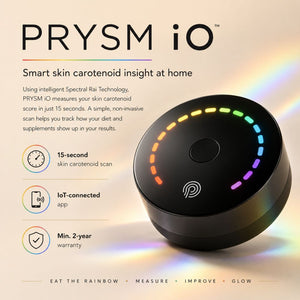
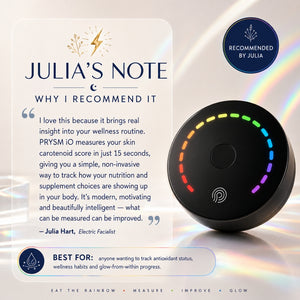
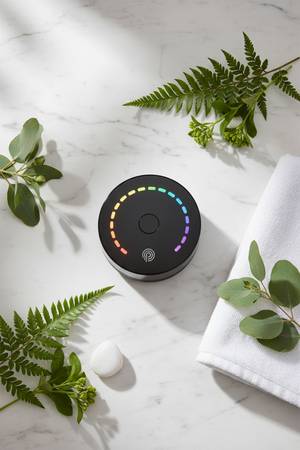
This interest in carotenoids also connects with PRYSM iO, which uses a non-invasive optical fingertip scan to generate a skin Carotenoid score.
I find this an interesting way to bring the conversation about nutrition closer to the skin. It gives us a measurable marker to follow alongside our daily habits.
There is an important distinction, though. A PRYSM score is not an individual Astaxanthin reading, a collagen measurement or a complete assessment of antioxidant protection. A change in score cannot, on its own, prove that Ingenious Collagen+ is working.
Curious about your skin carotenoid levels? Explore PRYSM iO, which uses a simple optical fingertip scan to generate a skin Carotenoid score.
Its role here is to support the wider conversation about Carotenoids and skin from within, rather than validate this particular supplement.
Julia’s Note
What interests me about Astaxanthin is its relevance to the processes that influence how skin ages.
My approach to ageing better includes the barrier, consistent daily care and supporting skin from within. The research on Astaxanthin gives us a useful reason to look more closely at antioxidant support alongside collagen and hydration.
For the wider picture, read Feed Your Skin From Within, where I explore how nutrition and consistent daily habits fit into my approach to skin longevity.
There is still more to learn. But it is an ingredient with an interesting history, a credible scientific rationale and early human research worth paying attention to.